
The development of the infant is not just a series of motor milestones checked off during medical visits. Several parameters, often underestimated in mainstream guides, influence the quality of this development: early postural tone, calibrated sensory exposure, and the psychological state of the parent carrying the child. Here, we provide an overview focused on the subtle points that make a difference in the daily support of the baby.
Fractioned tummy time and prevention of positional plagiocephaly
Since the widespread adoption of back sleeping, cases of positional plagiocephaly have notably increased. The clinical response can be summed up in one word: fractioned and progressive tummy time. The updated recommendations from the HAS and pediatric societies specify that this tummy time should be integrated as playtime, never as an immobile constraint.
Related reading : News, tips, and advice for enjoying retirement and aging well
In practice, we recommend starting with very short sequences from the first weeks, on the parent’s chest. The baby finds a soft support, a familiar olfactory stimulus, and close visual contact that promotes cervical tone.
As the infant gains strength, sequences on a firm mat on the floor take over. The goal is not duration but regularity: several short sessions per day are better than a single long session that tires the baby and generates crying.
See also : Discover an exciting world dedicated to animals and their well-being
- Before two months: a few minutes on the parent’s chest, two to three times a day, while monitoring head position.
- Between two and four months: gradual transition to the floor mat, with a contrasting toy placed at eye level to encourage cervical lifting.
- After four months: natural lengthening of sequences, observing fatigue signals (face rubbing, restlessness, crying).
This protocol reduces the risk of cranial deformation while stimulating overall motor skills and postural control, two prerequisites for subsequent motor acquisitions (rolling over, sitting, crawling).
To keep up with recent news on these topics and find additional resources, several specialized platforms compile verified content, such as Vive Mon Bébé, which gathers advice and practical guidelines for parents.
Screen exposure before age 3: what recent epidemiological data says
The French position on screens has hardened. Since 2024, the Commission for the First 1000 Days and the Professional Federation of Physicians in France recommend a total absence of screens before age 3. It is no longer just about limiting passive screen time in front of a television: any exposure, including so-called educational apps on tablets, is included.
Consolidated epidemiological data from 2022 to 2024 establishes a link between early screen exposure and three types of disorders: language delays, attention disorders, and sleep disturbances. The mechanism is twofold. The screen captures the infant’s attention with rapid visual stimuli that short-circuit natural sensory exploration. At the same time, time spent in front of a screen replaces direct verbal interactions, impoverishing the language environment.
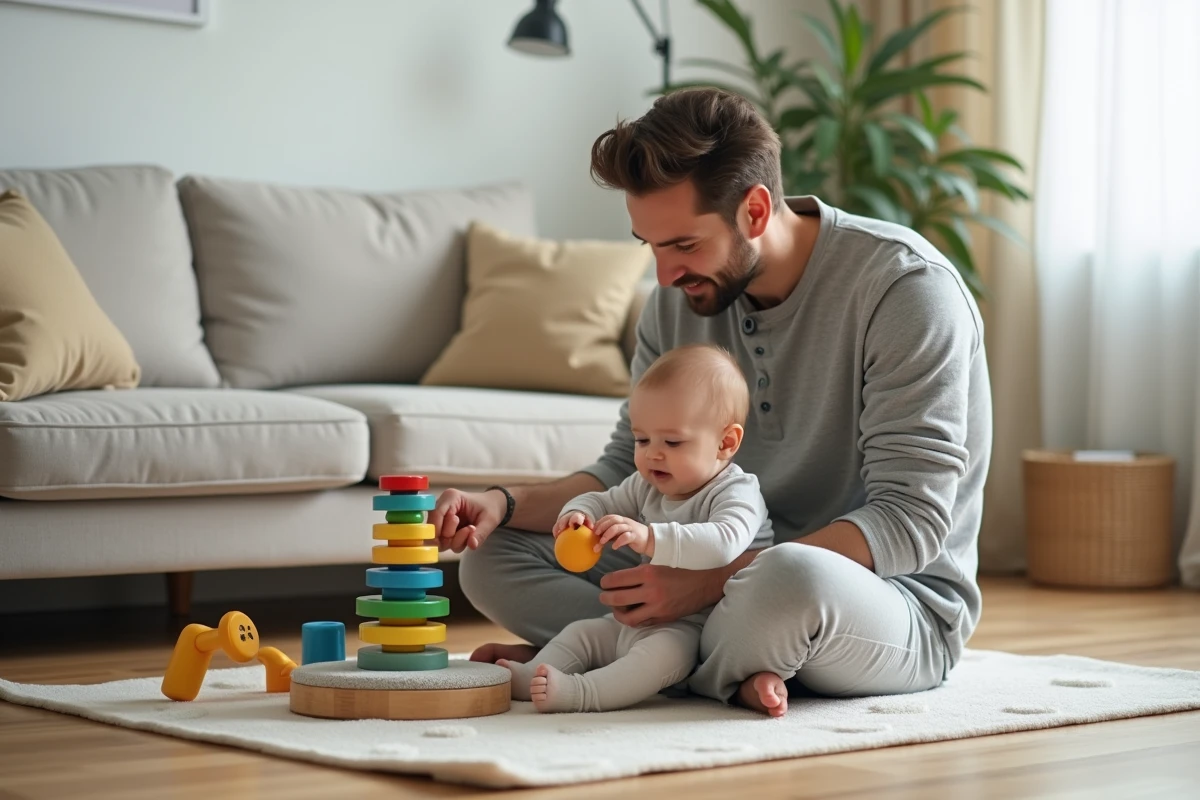
In consultations, we observe that the most informed families do not seek a digital substitute for the baby’s free time. They rely on simple objects: sound rattles, board books, water play. These tools simultaneously engage hand-eye coordination, touch, and hearing, without overloading attention.
Concrete alternatives to screens for stimulating language
Language is built through exchange. Talking to the baby during daily routines (diaper changes, meals, baths) is the most powerful lever. Naming objects, describing ongoing actions, leaving pauses for the infant to vocalize in return: this asymmetrical conversational pattern lays the groundwork for verbal understanding long before the first words.
Nursery rhymes and finger games add a rhythmic and prosodic dimension. The alternation of sounds, gestures, and looks creates a predictable framework that reassures the baby and encourages vocal participation.
Screening for postpartum depression and infant development
The perinatal plans for 2023-2024 have integrated a paradigm shift: the psychological well-being of the parent is part of the baby’s follow-up. Systematic screening for postpartum depression and parental anxiety is now recommended in the early months.
This is not a cosmetic addition. A parent suffering from psychological distress inadvertently reduces the quality and frequency of interactions with their infant. Eye contact, voice, emotional availability—everything that nourishes secure attachment is affected. The impact on the baby’s development is direct and measurable, particularly on social skills and language.
Guidelines for professionals and parents
Identification relies on validated tools (standardized questionnaires provided during consultations in the first trimester postpartum). But it also depends on clinical observation: a parent who avoids eye contact with their baby, describes disproportionate fatigue, or expresses feelings of detachment deserves thorough listening.
- Systematically offer a dedicated interview about the parent’s emotional state during consultations in the first and second months.
- Promptly refer to specialized support (perinatal psychologist, PMI, perinatal network) as soon as warning signs appear.
- Remind that asking for help is not a sign of parental failure, but a protective skill for the baby.
Parental mental health and infant development form an interconnected system. Supporting the baby also means taking care of the adult who carries them. Early childhood professionals who integrate this dimension into their daily practice observe a tangible improvement in the quality of parent-child interactions, and by extension, in the baby’s acquisitions in their first months of life.