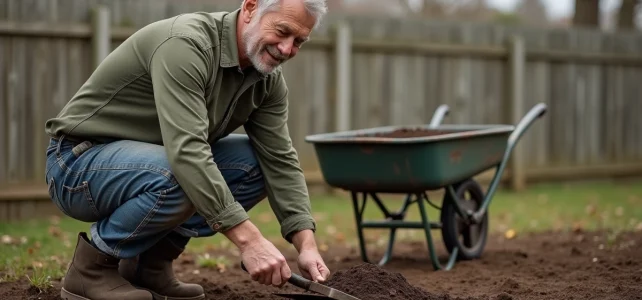
Before sowing any seeds, the quality of the lawn is determined below the surface. Soil amendment, leveling the ground, and choosing organic materials: every decision made during preparation affects the density, resilience, and water needs of the lawn for the years to come. What parameters should be measured, and what discrepancies in results are observed depending on the chosen methods?
Regulations on fertilizers: what changes for lawn amendments
The European regulation on fertilizer products imposes limits on heavy metals (cadmium, lead, mercury) for all amendments marketed within the Union. Products that exceed these thresholds can no longer be sold with a CE marking.
For lawn preparation, this constraint directly impacts the choice of available mineral and organic amendments in garden centers. Composts that do not comply with the NF U 44-051 standard are gradually being removed from the market. Checking the product’s compliance before purchase helps avoid introducing pollutants into soil intended for a sustainable lawn.
Mastering lawn preparation with amendment and leveling blade requires starting from analyzed soil and tracked materials that comply with this regulation.
Organic amendment or leveling sand: a comparison of effects on soil
The choice between an organic amendment (standard compost, composted wood chips) and a massive addition of sand to level the ground is not a matter of preference: the measured effects on water retention and soil structure diverge significantly.
| Criterion | Organic amendment (standard compost) | Leveling sand alone |
|---|---|---|
| Water retention | Significant increase in retention capacity | Low retention, rapid drainage |
| Soil structure | Improvement in aggregate stability | Little effect on aggregate cohesion |
| Nutritional contribution | Slow release of nitrogen, phosphorus, potassium | No nutritional contribution |
| Regulatory compliance | NF U 44-051 standard | No specific standard for lawns |
| Adaptation to watering restrictions | Recommended by Cerema (note 2024) | Not recommended in drought conditions |
The technical note from Cerema published in 2024 explicitly recommends favoring organic amendments rich in stable organic matter rather than massive sand additions, in order to increase water retention capacity and limit watering needs. In a context where drought orders have multiplied since the summer of 2022, this choice is no longer a comfort option.
On the other hand, sand still plays a specific role in correcting minor surface irregularities after the organic amendment, provided it does not constitute the main layer.
Minimal soil work versus deep loosening: INRAE data
The temptation to till the ground deeply with a tiller before sowing remains ingrained in common practices. A study conducted by INRAE, published in the journal Agronomy for Sustainable Development in 2023, questions this approach for urban lawns.
The results show that reducing soil work improves aggregate stability and limits erosion, while maintaining a comparable vegetation cover to traditional deep loosening and tilling methods. A light scarification, without turning over the soil, is sufficient to prepare the surface for sowing.
This data has direct practical consequences:
- Leveling can be done with a blade or a long rake after a simple surface scratching, without disrupting the soil horizons
- Earthworm and microorganism populations remain in place, which accelerates the natural structuring of the soil after sowing
- Working time decreases, as tilling and reassembling the soil are eliminated
Deep tilling remains justified in one specific case: an extremely compacted soil, where root penetration would be physically impossible without mechanical decompaction. For the majority of gardens, minimal work produces an equivalent result with fewer risks.
Leveling the ground before sowing: the method that limits rework
A poorly leveled ground creates pockets of standing water after each rain, areas where the grass yellows or dies from root suffocation. Leveling does not aim for a perfectly flat surface, but a consistent slope of a few centimeters per meter to ensure natural water drainage.

The sequence that reduces the number of reworks after sowing follows a precise logic:
- Spread the organic amendment evenly over the entire surface, then incorporate it by superficial scratching
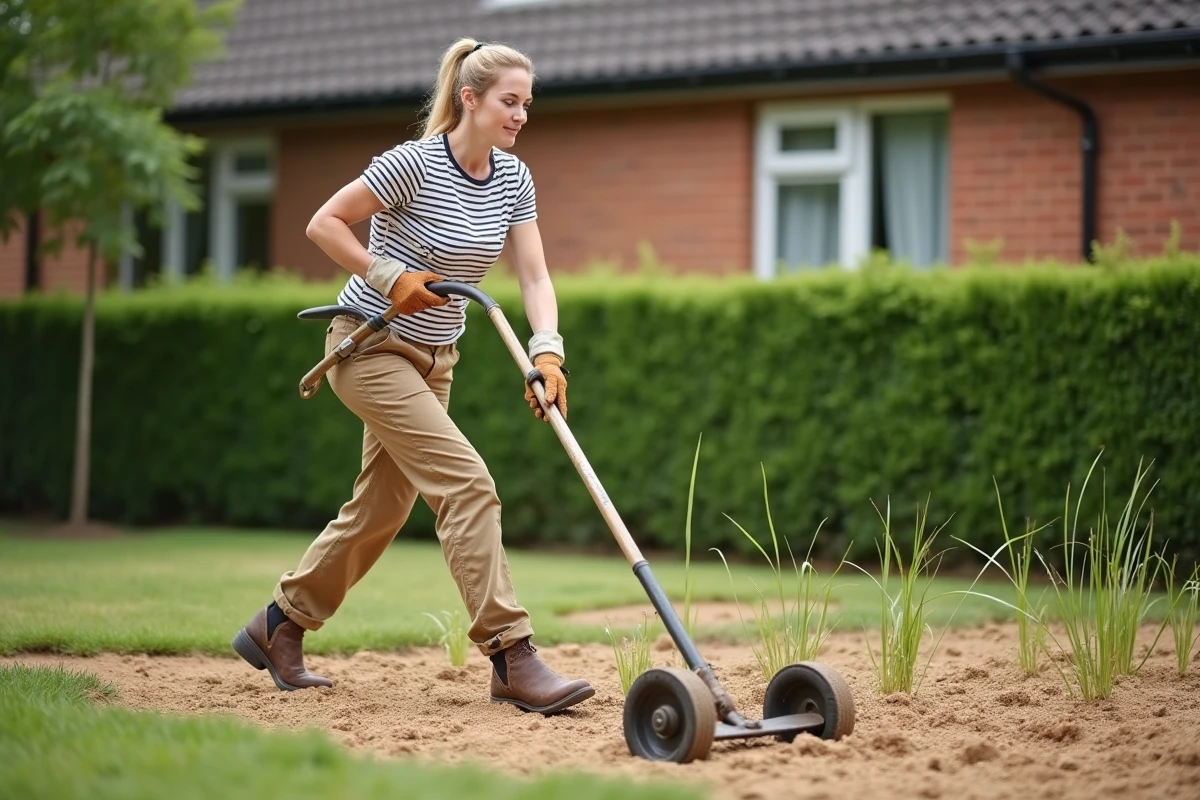
- Level the ground with the leveling blade (or a mason’s rule for small areas) by crossing the passes perpendicularly
- Let the ground rest for a few days and identify any depressions after rain or light watering, then correct before sowing
- Roll on moist but not waterlogged soil to close air pockets without creating excessive compaction
The rolling occurs before sowing and not after, contrary to a common belief. Rolling after sowing compresses the seeds on the surface and reduces seed-soil contact in uncorrected micro-depressions. A second light pass after sowing can complement, but structural leveling should be done beforehand.
Soil pH and lawn: the measurement to take before any amendment
Amending soil without knowing its pH is like correcting a problem blindly. Most lawn grasses thrive in a pH between 6.0 and 7.0. An overly acidic soil blocks phosphorus assimilation, while an overly alkaline soil limits iron absorption.
A pH analysis kit available at garden centers provides sufficient indication to guide the choice of amendment. An acidic soil will benefit from lime or dolomite addition. A basic soil will require an acidifying amendment such as elemental sulfur or an acidic compost (composted conifer chips).
Measuring pH after amendment, and not just before, allows for verification that the correction has reached the target range. This second measurement, often neglected in most guides, helps avoid sowing on still unsuitable soil and discovering failure weeks later.
The most structuring data for the success of a lawn remains this: a well-amended and properly leveled soil reduces the need for watering and fertilizers for the entire lifespan of the lawn. Savings are noticeable every summer, especially under water restrictions.