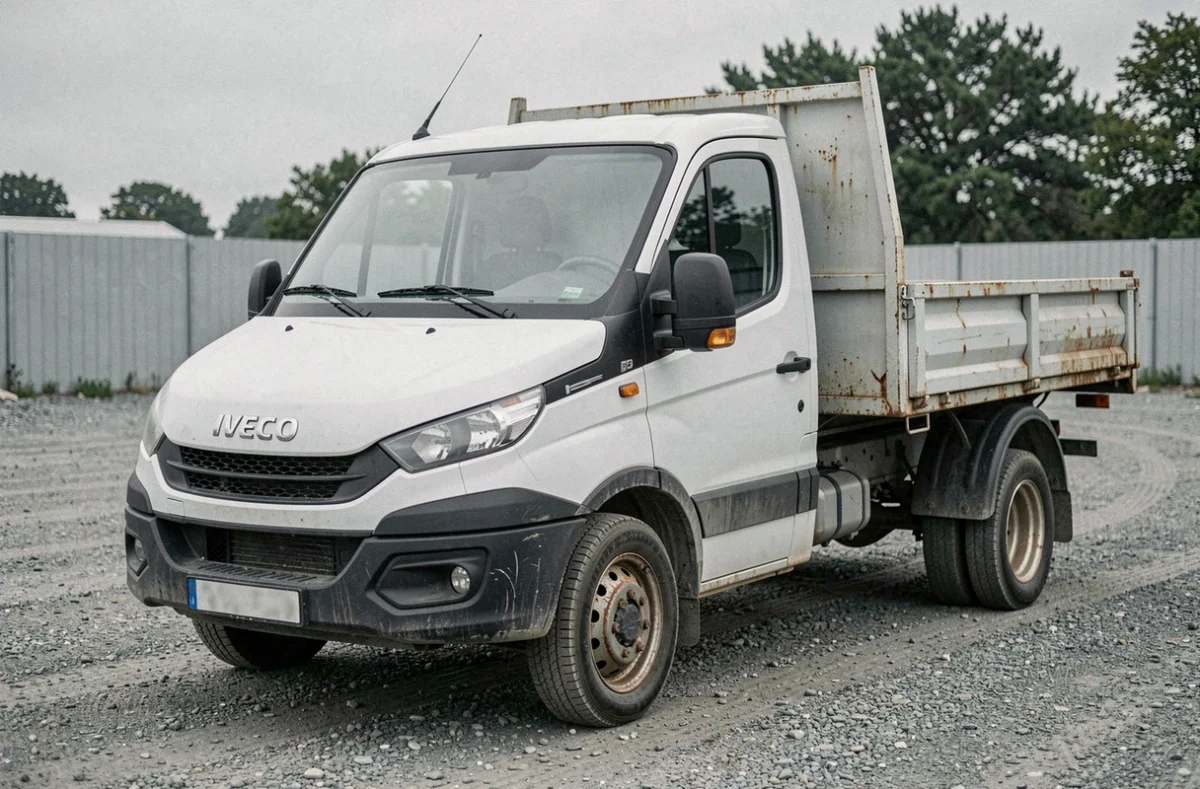
A 3.5-tonne Iveco Daily tipper truck advertised second-hand at an attractive price says nothing about its actual capacity to carry materials or whether it can access urban construction sites.
The 3.5 t GVW sets a total weight limit, not a payload limit: once you account for the tipper body, crew cab and equipment, the weight available for rubble or soil can be significantly reduced. Before comparing listings, these technical and regulatory constraints are what determine whether the purchase will be worthwhile.
Actual payload of a 3.5-tonne Iveco Daily tipper
The most costly misunderstanding is the difference between GVW and payload. The 3.5-tonne GVW is the maximum permitted weight of the vehicle when loaded and on the road. To find out what the tipper can actually carry, you need to subtract its unladen weight in its actual configuration: cab chassis, steel or aluminium tipper body, any auxiliary crane, toolbox and side guards.
On an Iveco Daily 35C fitted with a steel three-way tipper body and a single cab, the remaining payload is often far lower than buyers expect when they see “3.5 t”. Add a crew cab to carry a team, and the margin shrinks further.
Before arranging a viewing, ask for the registration document and check sections F.1 (maximum laden mass), F.2 (GVW) and G.1 (unladen weight). The difference between F.2 and G.1 gives the theoretical payload. In practice, weigh the equipped vehicle at a weighbridge: accessories added after registration, such as reinforced tailgates or side extensions, are not always listed on the registration document. When choosing the right Iveco tipper truck, a weighbridge check is the only reliable way to confirm its weight.

Crit’Air sticker and access to LEZs: the trap of older diesels
A low-priced used diesel Iveco Daily is often fitted with a Euro 3 or Euro 4 engine. The Crit’Air sticker assigned to the vehicle depends on its Euro emissions standard or first registration date, and determines whether it can enter low-emission zones.
The problem is that each local authority sets its own restrictions and exemptions. A Crit’Air 3 vehicle allowed in one urban area may be banned in another. For a tradesperson whose jobs are in city centres, a Daily rated Crit’Air 4 or 5 can become unusable for part of the week—or even all the time.
A tipper truck may sometimes qualify for a local exemption allowing it to enter an LEZ, but this is not automatic. Check with the relevant local authority to confirm the vehicle is eligible before relying on an exemption. Buying a Euro 3 Daily expecting to get an exemption, only to find out it does not qualify, can turn a bargain into a vehicle you cannot use.
Checks to make before signing
- Identify the exact Euro standard on the registration document (section V.9) and ask for the corresponding Crit’Air sticker, or use the official website to check which one applies.
- List the LEZs in the towns where the vehicle will be driven and check the current municipal regulations, not last year’s.
- Contact the local authority to find out whether a specific exemption exists for construction tipper trucks and what documents are required to qualify.
Commercial vehicle roadworthiness test: what listings leave out
A category N1 commercial vehicle such as the 3.5-tonne Iveco Daily follows a different roadworthiness testing schedule from a passenger car. The periodic test is valid for two years, but an additional emissions test is also required between periodic tests.
Many listings say “roadworthiness test passed” without specifying when the next emissions test is due. A vehicle bought with a recent periodic test may need an emissions test within the next few months, with the risk of a retest if the diesel engine is showing significant wear (worn injectors, a turbo nearing the end of its life or a clogged particulate filter).
Always ask for both test reports: the periodic test report and the additional emissions test report. Check the respective due dates. An older diesel with an emissions test coming up soon represents a hidden financial risk, especially if bringing it into compliance means replacing the injectors or regenerating the DPF.
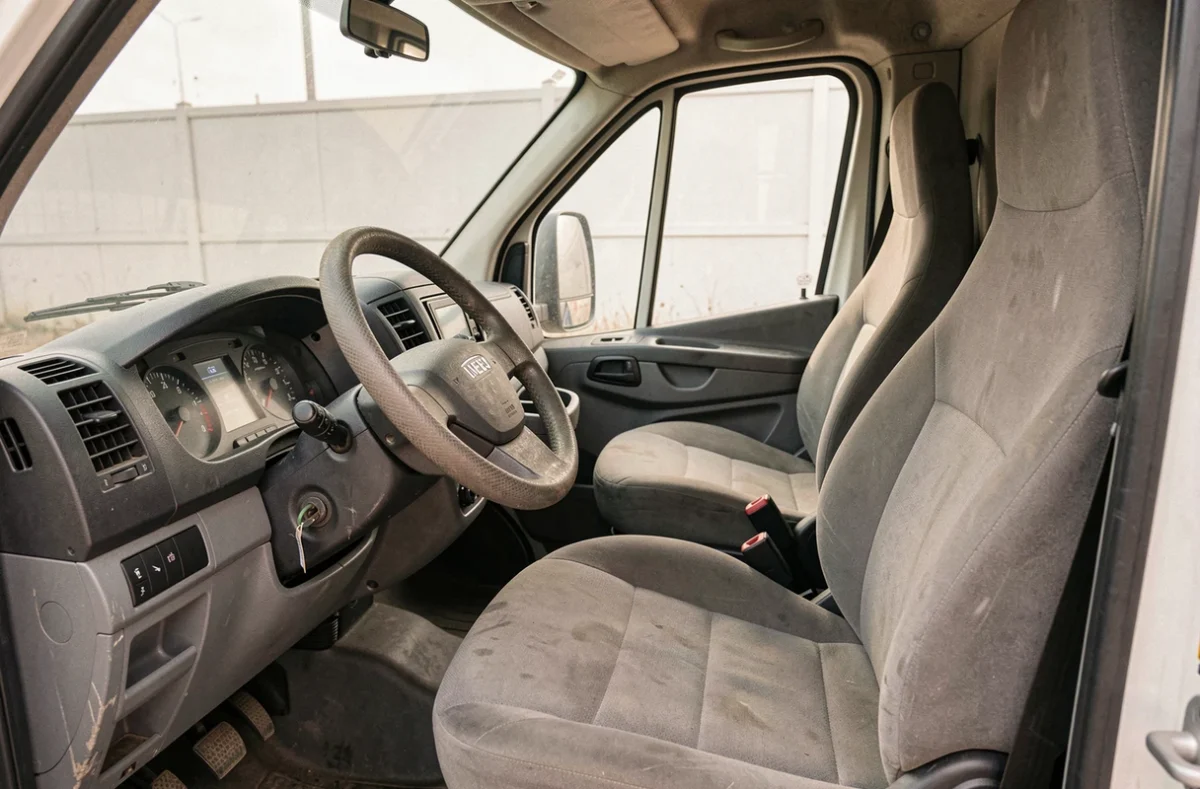
Engine and mileage: what to look for in a used diesel Daily
The Iveco Daily 35C is available with several diesel engines. The most common versions on the used market are the 2.3-litre and 3.0-litre models. The right choice depends on how you plan to use the vehicle.
The 2.3-litre engine is suitable for urban and suburban journeys with moderate loads. Fuel consumption is relatively low, and spare parts are widely available. The 3.0-litre engine delivers more power and torque, making it better suited to jobs involving frequent heavy loads or road transport with a full tipper.
Wear points to inspect based on mileage
- Rear suspension springs: on a Daily tipper used under load, the leaf springs gradually sag. A vehicle that sits low at the rear when empty may have worn springs, and replacing them is no small expense.
- Tipper ram and hydraulic system: check that the tipper raises and lowers under load, not just when empty. Leaks around the ram or an unusually slow lift may indicate a failing pump or worn seals.
- Clutch and gearbox: a Daily used on construction sites is constantly manoeuvring at low speeds. Its clutch will wear faster than that of a van used on the road with the same mileage.
- Chassis condition: check for corrosion beneath the tipper body, cracks around the mounting points and deformed chassis rails. Inspecting the underside on a vehicle lift is the best precaution.
The true cost-effectiveness of a used Iveco tipper truck
The purchase price of a used Daily tipper is only part of the total cost. Cost-effectiveness depends on three factors that are rarely considered together when searching for a vehicle: its actual payload (which limits the volume carried per trip), its Crit’Air rating (which restricts where it can be used) and its actual mechanical condition (which determines the cost of getting it back into service).
An older Daily advertised at a very low price but rated Crit’Air 4, with its payload reduced by heavy equipment and an emissions test due soon, can cost more over 12 months than a newer, more expensive model. The calculation should be based on the cost per tonne transported and per accessible job site, not the price shown in the listing.
Checking these three factors before every viewing helps avoid unpleasant surprises. A used tipper truck thoroughly inspected against these criteria can be just as dependable operationally as a new vehicle, provided you do not let the advertised price take priority over a proper assessment.