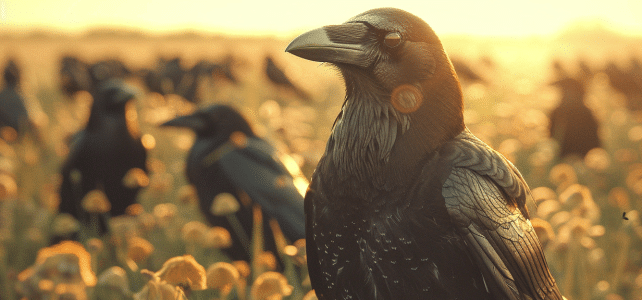
Crows, often perceived as mere urban birds, turn out to be creatures endowed with remarkable intelligence and complex social behaviors. A recent study dissects the social life of these black birds, paying particular attention to their interactions, their ability to use tools, and to transmit knowledge. Researchers have observed fascinating rituals, such as food sharing and individual recognition, which suggest that crows share more than a few behavioral traits with primates. This research deepens our understanding of avian cognition and social structures among birds.
Ecology and Adaptation of Crows in Urban Environments
The crow, a prominent member of the corvid family, stands out for its remarkable urban adaptation. These birds, which inhabit the vast Palearctic region, have managed to capitalize on the abundant resources of cities to thrive. The Corvus corone, with its developed cognitive abilities, skillfully exploits the mass waste produced by human activities, demonstrating an aptitude for taking advantage of the urban environment, contrasting with its image as a pest.
You may also like : Boxing: Beyond Sport, a Way of Life
This urban ecology, while beneficial for the species’ survival, nonetheless raises questions of natural conservation. The female crow, like the male, must navigate a landscape where challenges are not only dietary but also environmental, with the loss of natural habitats and pollution. The International Union for Conservation of Nature (IUCN) classifies the black crow as a species of least concern (LC), but this does not exempt the need for balanced management between urban development and ecosystem preservation.
The status of the crow as an intelligent bird allows it to adjust to rapid changes in its habitat. This bird, often deemed a pest, reveals rather an adaptability that could serve as a model for understanding the dynamics of urban ecosystems. Thus, nature conservation in urban settings depends on a harmonious coexistence, where understanding the cognitive abilities of crows plays a key role in developing environmentally respectful management strategies for all forms of life.
Recommended read : The Iconic Bridges of France: A Historical and Romantic Journey
Social Structure and Intelligence of Crows
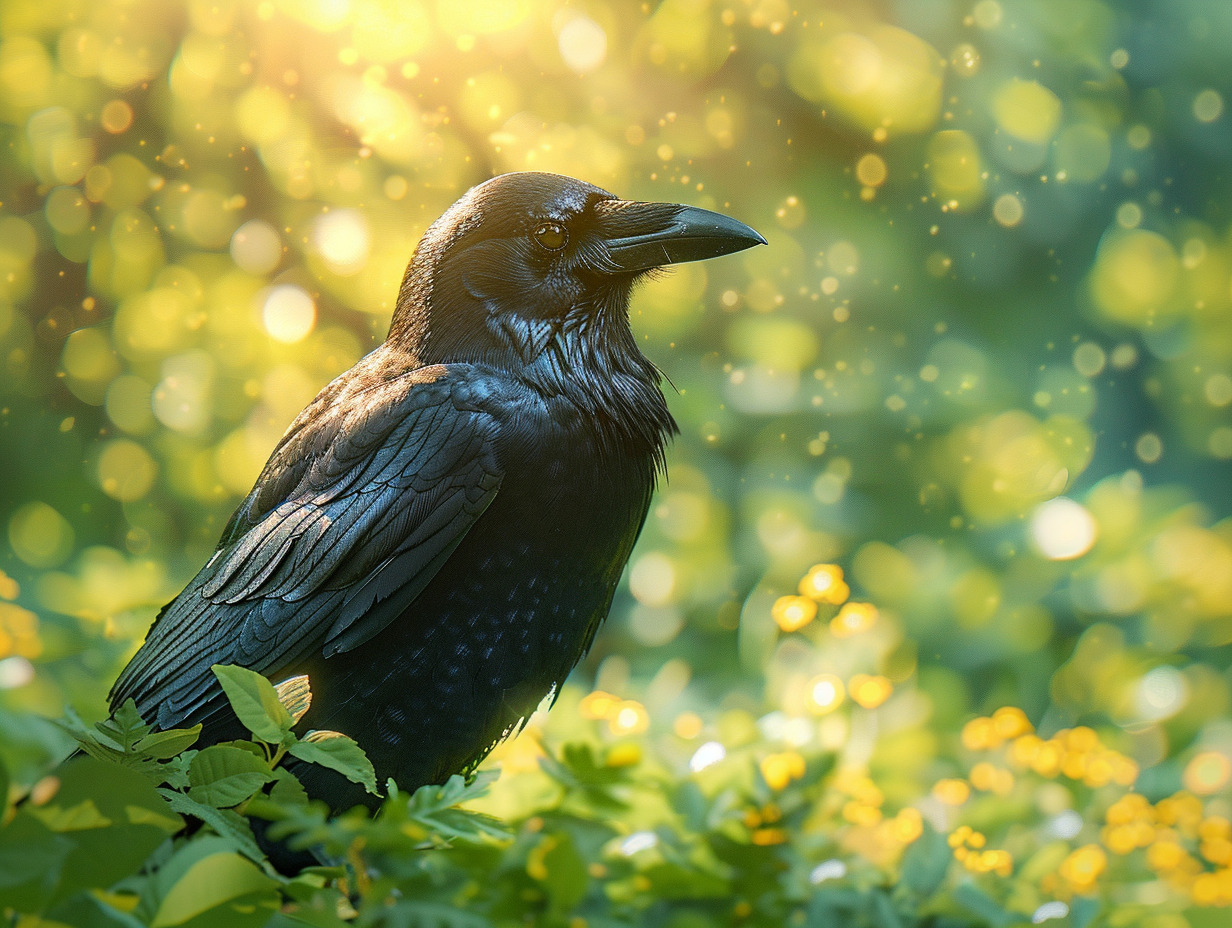
Social life in the black crow (Corvus corone) is marked by a complex social structure, which highlights their proven intelligence. These birds, with their elaborate social behaviors, demonstrate a form of cooperation particularly in their strategy of cooperative breeding. Within this dynamic, some individuals, often young and without their own offspring, assist breeding pairs in raising their chicks. This altruistic behavior, uncommon in the animal kingdom, underscores the degree of sophistication in their social organization.
The intelligence of the crow does not stop at its social interactions. It also manifests in its ability to solve complex problems, a capacity that could almost be described as cognitive. Studies show that these birds can use tools, remember human faces, and even understand abstract concepts such as emptiness and causality. These findings, detailed in behavioral studies, prompt us to reconsider the notion of intelligent birds and their place in the animal world.
The crow’s diet, being omnivorous, also reflects its great adaptability. Black crows are not exclusively dependent on a single food source, which makes them resilient to variations in their environment. They exploit a variety of food resources, ranging from seeds and insects to waste produced by humans. This dietary flexibility is another facet of their adaptability and survival.
Analyzing the cognitive abilities of the black crow cannot be done without considering the impact of their environment. Their animal behavior in urban settings, often wrongly perceived as harmful, is rather a testament to their ingenuity. Their presence in the city, far from being merely a nuisance, reflects a continuous and evolving interaction with human urbanization. Therefore, let us observe these birds not as intruders, but as actors in our urban ecosystems, whose social behaviors and intelligence are keys to understanding the interaction between humans and nature.